
Don't risk your grade
because of hallucinated AI citations.
Upload your essay, paper, or thesis and get an instant integrity check.
See what's broken before your professor does.
doesn't appear in Nature Methods vol. 19.
Watch a draft get checked,
start to finish.
A short walkthrough: upload a draft, watch every reference get verified against five academic databases, and see exactly what the report flags.
The video loads from YouTube only after you press play.
Don't trust AI citations
AI-generated citations can contain inconsistent authors, dates, journals, or source identifiers.
Hartman, R. J., & Liang, P. (2019). The role of spaced repetition in undergraduate exam performance: A meta-analysis. Journal of Educational Psychology Review, 41(2), 188-204.
Sweller, J. (1988). Cognitive load during problem solving: Effects on learning. Cognitive Science, 12(2), 257-285.
Okafor, C., & Bennett, S. M. (2021). Dual-coding strategies and multimedia learning in digital classrooms. Journal of Digital Learning Research, 8(4), 332-349.
Roediger, H. L., & Karpicke, J. D. (2006). Test-enhanced learning: Taking memory tests improves long-term retention. Psychological Science, 17(3), 249-255.
Vance, D. R., Whitfield, A., & Romano, K. (2017). Interleaved practice and the illusion of competence in mathematics learning. Cognition and Instruction Quarterly, 29(1), 45-59.
These citations look legitimate, but are they real?
Verify in seconds with Check My Thesis
Hartman, R. J., & Liang, P. (2019). The role of spaced repetition in undergraduate exam performance: A meta-analysis. Journal of Educational Psychology Review, 41(2), 188-204.
Sweller, J. (1988). Cognitive load during problem solving: Effects on learning. Cognitive Science, 12(2), 257-285.
Okafor, C., & Bennett, S. M. (2021). Dual-coding strategies and multimedia learning in digital classrooms. Journal of Digital Learning Research, 8(4), 332-349.
Roediger, H. L., & Karpicke, J. D. (2006). Test-enhanced learning: Taking memory tests improves long-term retention. Psychological Science, 17(3), 249-255.
Vance, D. R., Whitfield, A., & Romano, K. (2017). Interleaved practice and the illusion of competence in mathematics learning. Cognition and Instruction Quarterly, 29(1), 45-59.
3 out of 5 citations were hallucinated!
Review flagged citations and source matches
Four checks, one upload,
zero surprises at submission.
Catch every hallucinated citation
Submit knowing every reference can be traced to a real source. We check your paper against eight academic databases and flag citations that are invented, outdated, or formatted incorrectly.
- Checked against 200M+ scientific papers
- Preprints mapped to published versions
- Export corrected BibTeX in one click
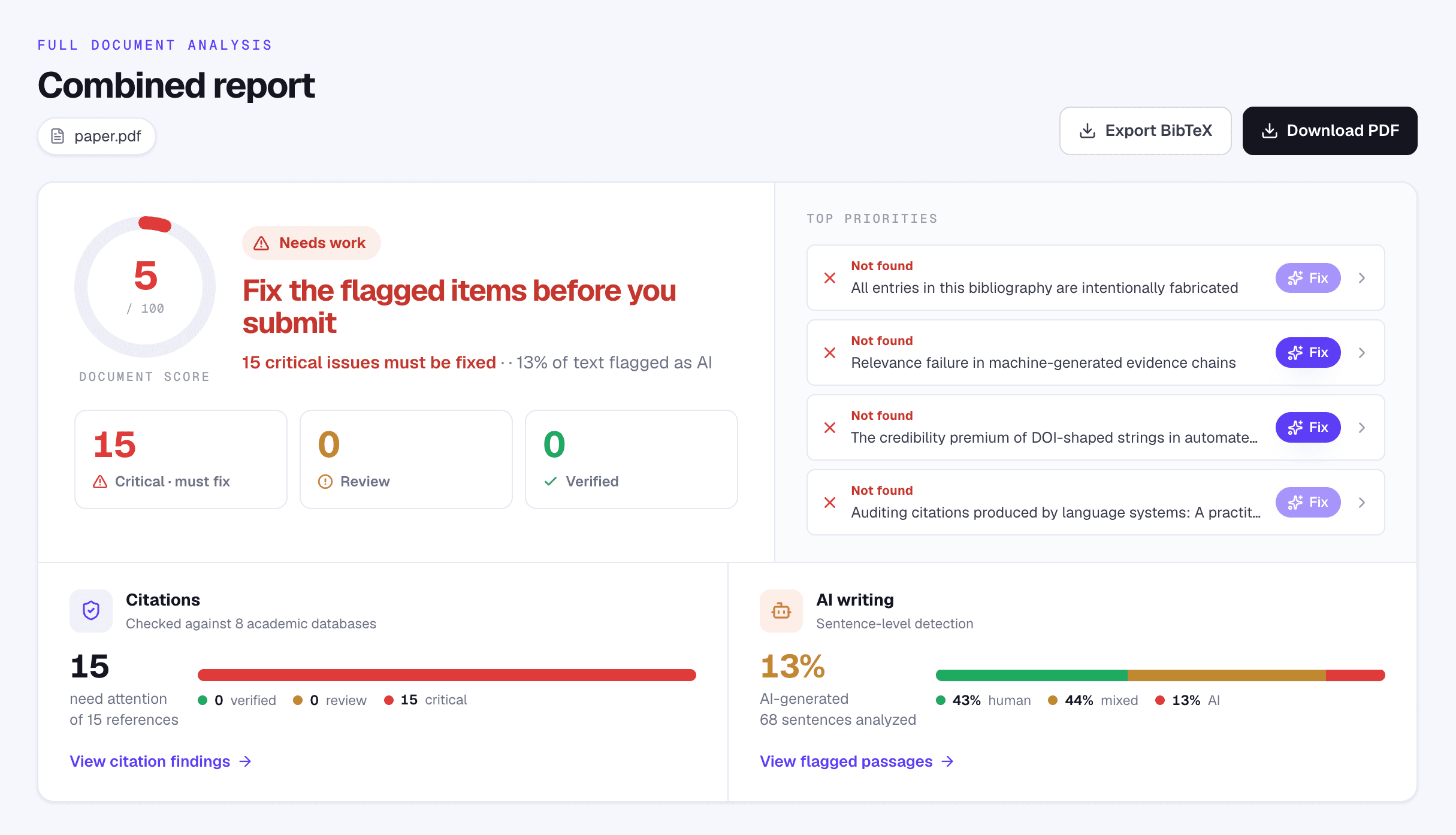
Broken reference? Fixed in one click
Replace a broken reference with a source you can defend. You see why it was flagged, get a verified paper that supports your claim, and copy the citation in the style your university expects.
- Explains why each reference was flagged
- Suggests a verified replacement that fits your claim
- Copy it in APA, MLA, IEEE, Harvard, or BibTeX
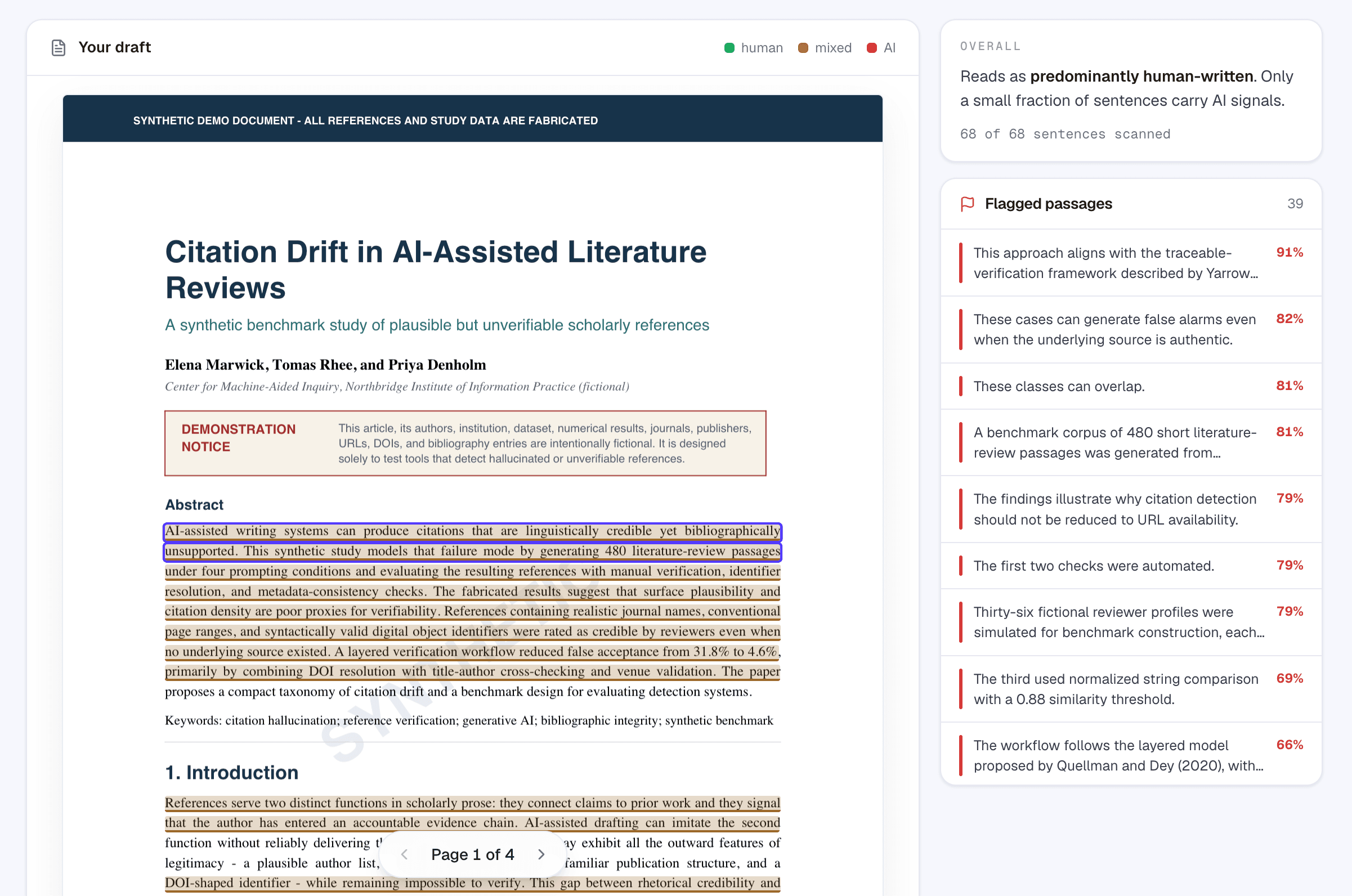
Know exactly which sentences are flagged as AI-generated
See which sentences could look AI-written before you submit. Sentence-level highlights show you where to revise, so the final draft reads like your own work.
- Sentence-level detection for ChatGPT, Claude & Gemini patterns
- Color-coded highlighting: human, mixed, and AI
- Paragraph-level confidence scoring
Cited a preprint? Get the published version
Keep your reference list current without hunting for publication details. We find the journal or conference version of each preprint and give you the correct authors, venue, year, and DOI.
- Preprints matched to their published versions
- Corrected authors, venue, year, and DOI
- Match confidence and a direct link to the paper
Simple pricing. Powerful draft check.
Every document scan includes citation verification and AI detection. Pay once for 3 scans, or get 30 days of unlimited use.
One-time payment for 3 document scans. Each includes citation verification and AI detection, never expires, and can be topped up any time.
One-time payment for unlimited document scans for 30 days. Every scan includes citation verification and AI detection; access ends automatically.
Pay once. Access expires after 30 days, never auto-renews.
Frequently asked questions
Your deadline is close.
Your draft isn't ready.
Upload your PDF. 90 seconds later you know exactly what to fix.
Check my draft now